In-House Fulfillment vs. 3PL for Growing e-commerce Brands
Date:
March 23, 2026
Founder & CEO, Palletized eHub
Max Trujillo
As a business manager, scaling your e-commerce fulfillment operations forces you to choose between in-house fulfillment and partnering with a third-party logistics provider.
In-house fulfillment requires managing stock, picking, packing, and dispatch under your own roof, while a 3PL hands off warehousing, order processing, and returns to an external partner. Since this choice directly affects your margins, shipping speed, and customer experience, how do you know when the right time is to transition to a 3PL?
Comparing in-house fulfillment vs. 3PL
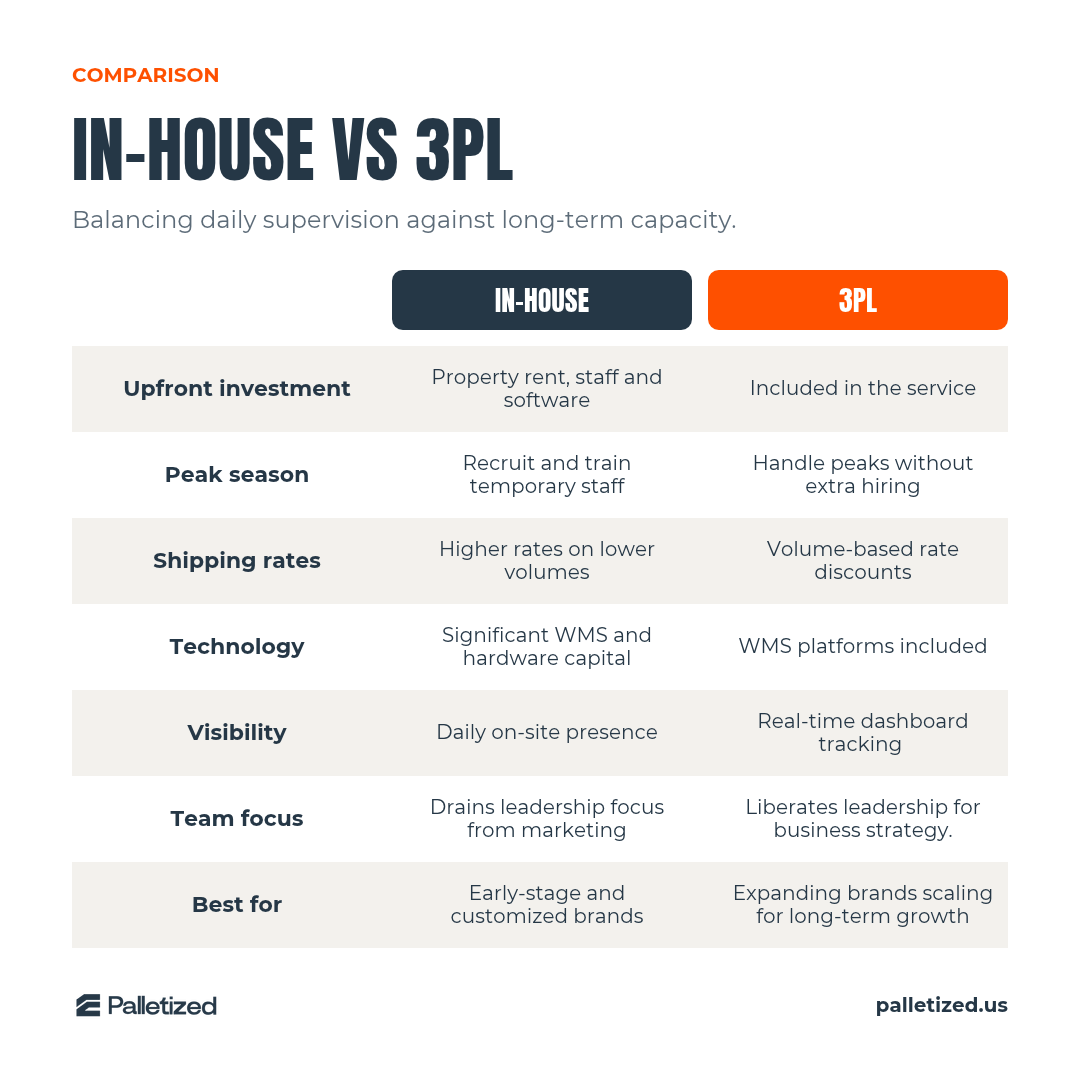
Selecting the right fulfillment model involves balancing daily control oversight with long-term scalability. To help you evaluate whether to manage orders internally or partner with a 3PL, here is a breakdown of how both approaches compare to one another:
What works best with in-house fulfillment
For growing e-commerce and highly customized brands, self-fulfillment provides several immediate operational advantages:
Total control over customer experience: You maintain absolute supervision over custom packaging, unboxing experiences, promotional inserts, and quality checks before dispatch.
Immediate operational flexibility: Executing real-time adjustments to item bundles, boxing supplies, or special offers requires no third-party coordination or unexpected fees.
Clear oversight at low volume: During the early stages of a business, self-fulfillment minimizes overhead while granting founding teams direct exposure to logistics workflows.
Where in-house fulfillment becomes challenging
Most founders underestimate the true cost of handling fulfillment internally. Managing logistics on your own creates significant operational friction:
Storage and capacity bottlenecks: Facility restrictions, congested workspace, and peak-season demand rapidly become major operational hurdles as order volume increases.
Distraction from primary growth: Time spent assembling packages, purchasing shipping supplies, and managing warehouse staff drains essential focus away from product innovation and marketing.
Higher shipping costs: Smaller dispatch volumes prevent your business from accessing the steep bulk shipping discounts negotiated by large logistics networks.
Unpredictable labor costs: Hiring dedicated warehouse employees entails base salaries, benefits, training resources, and extra temporary staffing during seasonal peaks.
Expensive software and hardware capital: Industrial Warehouse Management Systems (WMS), barcode scanners, and label printers demand significant upfront investment alongside ongoing software fees.
Rising property and facility expenses: Securing physical commercial warehouse space, along with utility bills, insurance premiums, and general maintenance, adds high fixed costs regardless of order volume.
What works best with a 3PL fulfillment
As order volumes expand, transitioning to a 3PL partner provides key operational advantages that support long-term business growth:
Scalability and flexibility: A 3PL effortlessly handles sudden volume spikes, holiday peaks, and flash sales without requiring extra space or hiring temporary staff.
Volume shipping discounts: Partnering with an established provider allows brands to use volume-based rate discounts and decrease shipping costs per order.
Reclaimed time and focus: Outsourcing logistics releases your leadership team to focus entirely on brand marketing, product development, and long-term strategy.
Specialized kitting and assembly: Fulfillment partners manage custom bundling, multi-packs, marketing inserts, and specialized packaging directly on the facility floor following your exact SOPs.
Amazon FBA and FBM compliance:Specialized 3PLs handle Amazon-compliant receiving, item barcoding, polybagging, and palletizing to eliminate compliance errors and expensive chargebacks.
End-to-end returns management: Outsourcing reverse logistics streamlines product quality checks, rapid restocking workflows, and root-cause reporting to maximize value recovery from returned items for the customer.
Real-time multi-channel tech and analytics: Modern WMS platforms automatically align orders and stock levels across platforms like Shopify and Amazon, providing real-time visibility from a single tracking.
Where 3PL fulfillment creates friction
Delegating fulfillment doesn't mean you have to relinquish control. You can prevent common 3PL bottlenecks by evaluating these critical areas:
Verify custom packaging and unboxing standards: Because large-scale 3PLs usually prioritize standardized processes, verify whether the team can carry out custom kitting, promotional inserts, and branded packaging following your specific SOPs.
Audit pricing structure and account minimums: Avoid unexpected setup costs or high monthly fees by examining a sample invoice to see how receiving, storage, handling, and returns fees are billed.
Ensure real-time multi-channel visibility: Prevent inventory blind spots by verifying that you have single-dashboard tracking across all sales channels instead of relying on manual inventory updates.
Demand direct communication and error accountability: Protect customer satisfaction by securing a named account manager who knows your product line and inquiring how accuracy is audited before orders ship out.
Discover how to overcome these fulfillment challenges with confidence here.
How to choose the right model for your brand
Deciding between in-house fulfillment and a 3PL partner depends on your current order flow, growth goals, and facility capacity. Use this quick comparison to determine which model best supports your brand's needs.
When to keep fulfillment in-house
When to move to a 3PL
Moderate order volume: Your current workspace and team effortlessly handle daily order self-fulfillment without operational friction.
Outgrown warehouse capacity: You are running out of storage room, managing inventory across fragmented locations, or struggling to maintain necessary stock levels for growth.
Bespoke packaging demands: Your e-commerce catalog relies on elaborate unboxing details, handcrafted touches, or highly customized assembly.
Rising errors and shipping delays: Your staff spends time fighting fulfillment errors and shipping delays during high-volume periods. As a result, your leadership loses precious hours instead of driving customer acquisition and strategic growth.
Direct quality control: Your staff requires continuous physical supervision and hands on evaluation before every delivery.
Overwhelming peak seasons: Holiday surges and promotional events result in operational bottlenecks, missed deadlines, and unsustainable overtime shifts for your staff.
Localized shipping focus: Your buyer base is located nearby, making multi-warehouse distribution unnecessary.
Multi-channel or marketplace expansion stalls: Expanding onto platforms like Amazon or Walmart introduces compliance guidelines that your internal team struggles to manage.
Localized shipping focus: Your buyer base is located nearby, making multi-warehouse distribution unnecessary.
Overwhelming peak seasons: Holiday surges and promotional events result in operational bottlenecks, missed deadlines, and unsustainable overtime shifts for your staff.
A boutique 3PL as the middle ground
Selecting a fulfillment strategy is not a strict choice between in-house execution and a distant, automated 3PL. A boutique 3PL connects these approaches by pairing the care, flexibility, control, and customized unboxing of internal logistics with the scalable software and shipping power of a large network.
Outsourcing physical distribution to a boutique partner combines the best of both worlds: you receive a dedicated account manager who knows your SKUs, centralized real-time stock visibility, exact custom packaging compliance, and effortless scalability during demand surges. When problems emerge, you communicate directly with a dedicated partner who knows your brand instead of filing a support ticket.
What is the main difference between in-house fulfillment and a 3PL?
The main difference centers around operational execution: in-house fulfillment uses your own workspace and employees to store and ship products. In contrast, a 3PL takes over the entire warehouse, picking, packing, and delivery process on your behalf using their infrastructure and technology.
Is a fulfillment center the same as a 3PL?
While people often mix up these terms, a fulfillment center is the physical warehouse where orders are processed and delivered. A 3PL (third-party logistics provider) represents the broader service partner that operates those facilities while managing supply chain services like inventory management, software integration, freight, and returns.
How can your brand move from in-house fulfillment to a 3PL?
Transitioning starts by evaluating your SKU catalog, past order metrics, and packaging guidelines. Once you select a compatible partner, you connect your e-commerce platform (such as Shopify) with their warehouse management system (WMS), ship your initial inventory batch, run test orders, and officially go live.
What questions should you ask a 3PL before switching?
Essential questions to evaluate potential partners include:
Technology and visibility: Which software integrations are built in, and how does live inventory tracking function across sales channels?
Brand Customization: What is your process for managing tailored packaging requirements, kitting projects, and specific promotional inserts?
Daily Operations: What are your daily operational deadlines for same-day dispatch?
Performance and Costs: What are your historical accuracy standards, performance guarantees, and cost structures for storage, picking, and delivery?