
Selecting the appropriate fulfillment strategy is crucial in an e-commerce business grow. If you balance multiple sales channels, depending exclusively on Amazon FBA might restrict your income and your control. This guide breaks down what works and how e-commerce sellers can optimize their business operations to scale smoothly.
Before diving into costs, it helps to see how each model works. Both options manage shipping orders, but they impact your business in particular ways.
Neither model wins on every front. Here is how they compare on features, costs, branding and returns.
This table summarizes how FBA and 3PL fulfillment services stand against each other on the points that shape the customer experience.
Evaluating prices line by line can be inaccurate, as your actual expenses rely on your sales velocity and channel mix. Since Amazon rewards rapid turnover, Amazon sellers must watch their inventory lifespan very closely. If your FBA inventory remains in the warehouse for too long, your storage costs will escalate significantly.
Amazon updates these charges regularly, so evaluate the current fees in Seller Central before you plan. With a third-party logistics partner, storage rules are set in your agreement, which makes your costs easier to forecast.
Amazon's fulfillment fees combine picking, packing, and delivering into one charge per unit, based on size and weight. A 3PL typically charges for picking and packing, and then applies carrier rates when shipping orders.
For small, fast-moving products, FBA's bundled fee is difficult to match. For larger items, bundles, or orders from other channels, compare your total cost per order across both models, including storage and prep.
How your customers experience your brand depends on how you fulfill your orders. FBA focuses on Amazon's fast delivery times and standards, while a 3PL adapts around your unique brand.
Under FBA, Amazon manages and processes returns for the orders it ships, following its own policies. Amazon staff evaluates the returned items, and some might be marked as unsellable or require a removal order to be sent back to you.
With a 3PL fulfillment provider, the returns process follows your own rules. At Palletized, our returns management specialists review each returned item and decide, based on your instructions, whether it goes back into inventory or requires another disposition. Restocked units can then be sold again on any channel.
There is no single right answer for every e-commerce business. Use these profiles to find yours.
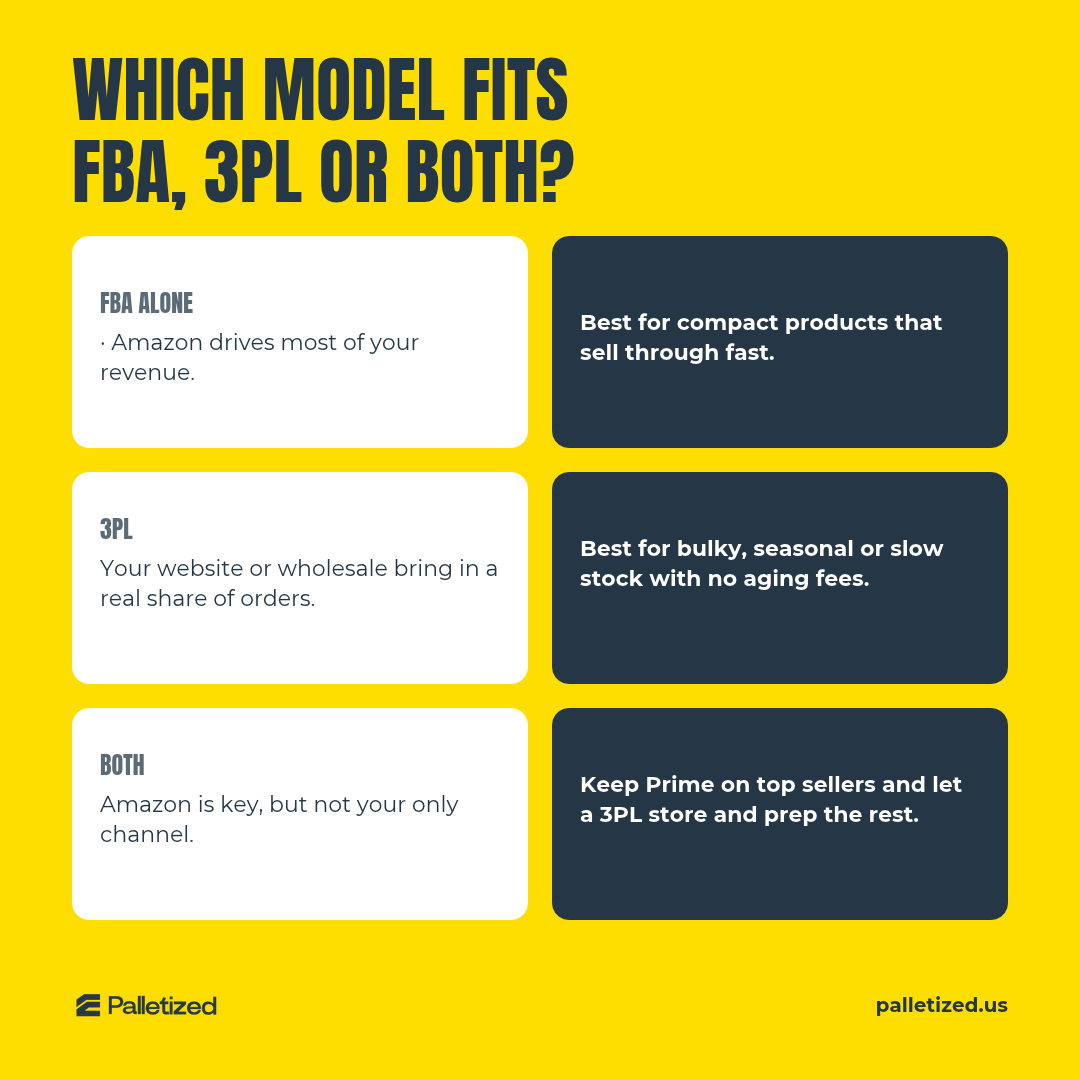
For many Amazon sellers, the choice is not one or the other. The hybrid model combines FBA for Prime-eligible Amazon orders with 3PL fulfillment services for everything else.
Instead of sending all your inventory straight to Amazon, you keep most of it at the 3PL and send smaller, regular shipments to FBA. That way you keep your Amazon listings in stock without paying FBA storage rates on all of your products. This kind of inventory management also protects you from Q4 storage spikes.
Location is crucial for brands that receive their collections. A Miami warehouse can import inventory by container, pallet, or box and store it right next to the port of entry for many international deliveries.
Operating from one inventory pool in Miami, a business can prepare FBA shipments, ship DTC orders, and supply wholesale accounts. That keeps your supply chain simple and your inventory in one place while each sales channel gets what it needs.
Choosing between Amazon FBA and a 3PL for any e-commerce business starts with your product velocity and your channel mix. For many brands, a hybrid approach keeps Prime on the best sellers while giving you more control over storage costs and packaging.
If you want your e-commerce business to work with the right fulfillment mix for your brand, contact our Palletized team to talk about your operation.
Amazon FBA operates essentially as a 3PL. Amazon owns the fulfillment centers and takes care of picking, packing, and shipping for every order it fulfills.
FBA charges depend on item size and weight. They consist of a fulfillment fee per unit and monthly storage costs, which multiply sharply from October to December and get higher for stock that has aged past 181 days.
There is no fixed number of sales. Businesses frequently adopt a third-party logistics partner when they begin selling on several channels, when Q4 storage costs hurt their profits, or when they require custom packaging.


© 2026 Palletized. All rights reserved.
Developed by
